
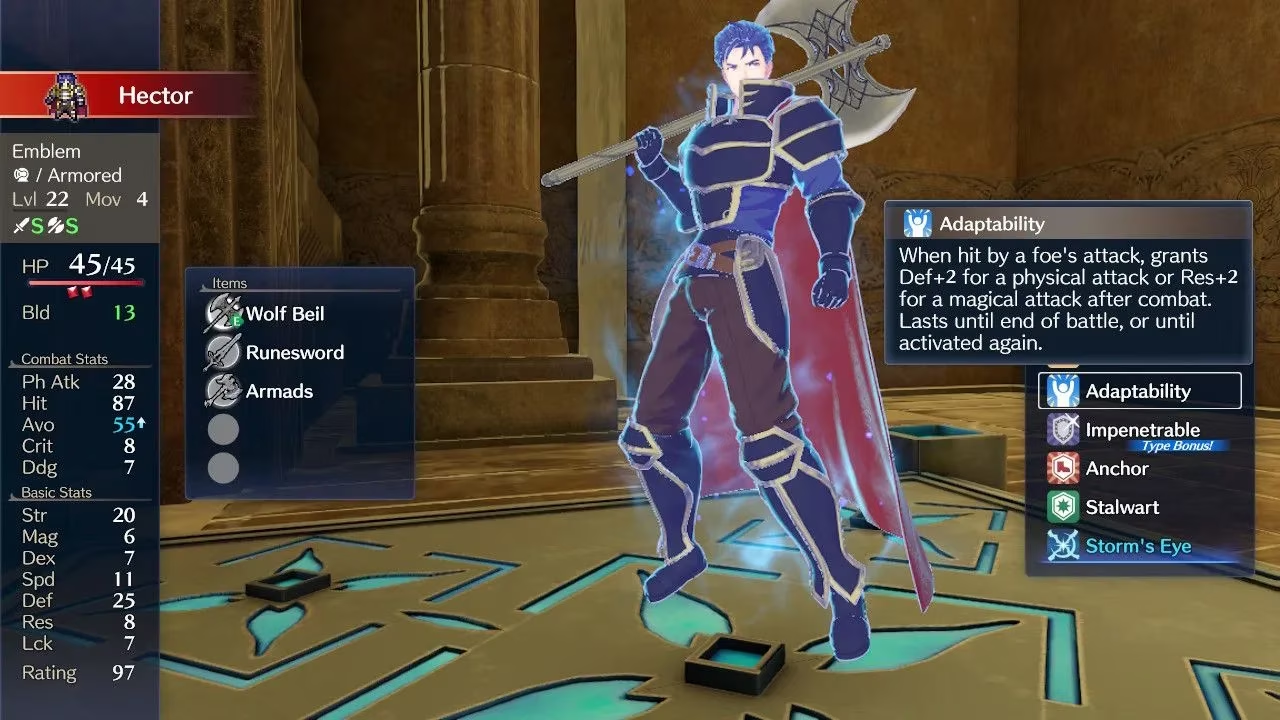
In 2026, Fire Emblem Engage still occupies a strange corner of the strategy RPG landscape. For every player who praises its polished combat, there is another who describes the skill inheritance system as a tantalizing shelf of locked glass jars. The game hands out powerful inheritable skills—Sigurd’s Canter, Marth’s Break Defences, and a constellation of cheaper utility picks—but the resource used to buy them, skill points, arrives at a pace that can feel like trying to irrigate a desert with a teaspoon. Three years after launch, the friction remains a frequent topic in community discussions, especially among players who treat unit building as the true endgame.

The system is deceptively simple on paper. Skill points accumulate at the same rate as experience, but only when a unit has an Emblem Ring equipped. Bond Rings do offer a route to progression, yet they reduce the payout, functioning like a leaky faucet compared with the full flow of an Emblem Ring. Because premium skills carry premium price tags, many players spend the majority of a playthrough without seeing half their army learn even one of the marquee abilities. Chapter after chapter, the counter ticks upward, while the Ring Chamber quietly displays the cheap, situational skills that could be taken right now.
That moment is where the design begins to twist against itself. Each visit to the Ring Chamber feels like browsing a carnival booth where a better prize hangs from a string that never quite snaps. A cheaper ability might provide an immediate magical boost or a narrow battlefield advantage, but committing to it can delay a long-planned purchase of Canter or Break Defences for several more chapters. The result is an uncomfortable choice: either accept a stopgap that will soon become irrelevant, or keep saving while the unit remains incomplete. For players who enjoy fine-tuning every build, this is less a meaningful trade-off and more a test of patience.
Previous entries in the Fire Emblem series handled this itch far more gracefully. Awakening and Fates let players reclass units with relative ease and experiment with skill combinations almost as freely as they wished. Three Houses added New Game Plus, allowing completed skills to return in a fresh run and encouraging deliberately broken, joyfully chaotic builds. Engage, by contrast, offers neither the flexibility of the older sandbox nor the second-run scaffolding of Three Houses. The ingredients for a deep customization system are present, but the supporting design choices are not.
The class system compounds the problem. Even a simple reclass requires weapon proficiencies that are earned through Emblem Ring usage, a process that consumes numerous battles and keeps those rings away from other units. Meanwhile, Engage’s random battles, which in earlier Fire Emblem games often acted as a gentle whetstone for under-leveled recruits, sometimes feel more like a grindstone that sharpens the player’s frustration instead of the roster. Players who want to test experimental builds can find themselves pushed away from the very activities that should make experimentation possible.
The expansion pass initially suggested that the developers recognized the drought. The first wave of downloadable content included items that instantly granted large sums of skill points, a shortcut that helped unlock a few key abilities without waiting for dozens of battles. Yet by 2026, many players describe that solution as a tourniquet on a wound that never closes. There are too many units, too many compelling skills, and too few realistic opportunities to earn skill points across a normal playthrough. Even with additional waves adding new Emblems and conversation routes, the underlying economy remains tight, and the pressure to optimize every point can make repeat runs feel less like a fresh puzzle and more like a repeat of the same arithmetic.
For theory crafters and build tinkerers, this is perhaps the most persistent disappointment in Fire Emblem Engage. The game’s combat engine is sharp, its maps are colorful, and its Emblem system creates genuinely novel tactical questions. But a strategy RPG that discourages experimentation is like a racing game with a beautiful track and a fuel tank that never fills. Players can admire the machinery, but they cannot take it on the long, strange journeys that made past Fire Emblems so replayable.
The following comparison summarizes the gap:
| Game | Skill flexibility | New Game Plus | Build experimentation feel |
|---|---|---|---|
| Awakening / Fates | High | No | Sandbox-like freedom |
| Three Houses | Moderate | Yes | Strong, especially in replays |
| Fire Emblem Engage | Theoretically high | No | Slowed by skill point drought |
By 2026, the hope among fans is not necessarily for a full redesign of Engage, but for future entries—or another substantial update—to treat skill points less as a scarce currency and more as a playground resource. Until then, Fire Emblem Engage remains a game of brilliant tactical parts that often keeps its deepest customization locked behind a very slow drip.