
The Somniel’s morning light filtered through the Ring Chamber, casting prismatic reflections over the polished stone. Alear had just returned from a skirmish on the Brodian border, and in the infirmary, a familiar hum of restorative magic filled the air. Framme, still clutching her first staff—a gift from the Divine Dragon itself—hovered over a wounded soldier with an intensity that belied her gentle nature. She had joined the army in Chapter 2 as a wide-eyed cleric, more enthusiastic than battle-hardened, but those early days already felt like a distant memory.
In the years since Fire Emblem Engage first arrived on the scene, her growth as a unit has been dissected, celebrated, and occasionally underestimated. Yet no amount of strategic analysis can capture the moment her 55% Speed growth—tied for the highest among the entire cast with Chloe, Lapis, and Fogado—first revealed itself in a frantic Defense chapter. An enemy axe-fighter swung, and Framme simply wasn’t there. She had darted aside, robes fluttering, already preparing a Mend. It was then that many commanders realized they weren’t nurturing a mere heal-bot; they were shaping an Avoid tank with the potential to rewrite the flow of battle.

But no legend is without its trials. For all her swiftness, Framme carries a flaw so pronounced it haunts every weapon choice: a base Build stat of 3 and, mercilessly, a 0% Build growth. This means that unless specific class routes are taken, nearly any weapon she wields will burden her with a Speed penalty. The sheer weight of a steel sword or a heavy tome can turn her lightning reflexes into sluggish jabs. Yet, rather than a dead end, this quirk became a puzzle. How do you sculpt a healer into a warrior when the very tools of war slow her down? The answer, as always, lies in the class change.
Across the Somniel’s training yard, conversation often circles back to three archetypes for Framme. First, Martial Master—the evolved form of her initial class. It grants her the ability to wield tomes alongside arts and staves, preserving her Chain Guard while opening up magical offense. The class doesn’t boost Build, but it lets her stick to lighter gear, and the versatility of toggling between a Physic staff and a Flux spell is invaluable in protracted fights. Some instructors swear by it, especially those who already field a magic-heavy squad.
Then there is the path of the Wolf Knight. This route transforms her into a hit-and-run predator, leveraging Daggers to pick off threats from the shadows. Wolf Knight feeds her Speed and Dexterity, and since knives are naturally lightweight, the Build problem diminishes. A Framme on this track becomes a whirlwind of precision, darting in to land a critical hit, then retreating before retaliation can land. She becomes something between an assassin and a medic—always moving, always ready with a Concoction in an emergency.

The third, and perhaps most poetic, is the Griffin Knight. She soars above the battlefield on wings of resolve, lance in hand. This class nurtures all her offensive stats, maintaining access to staves even as she becomes a frontline threat. The Build penalty still bites—lances are not light—but with access to the Javelin and Flame Lance, she becomes a mixed-damage terror. A Griffin Knight Framme is a statement: a declaration that no weakness is insurmountable if you have the right vantage point. It’s not uncommon to see commanders temporarily rotate her into General or Berserker for a couple of levels, fishing for a precious Build point through sheer force of will.
Equipment, too, tells a story. In the inventory screen, artifacts of her journey pile up. A Silver Dagger once used to fell a corrupted wyrm in Elusia. A Shielding Art that let her parry a killing blow meant for Alear. The weapon dilemma is real—without a Build fix, every forge stone spent must be weighed carefully. The community often leans toward Arts for the faithful Martial Master, Daggers for the Wolf Knight, and a balanced lance set for the aerial Griffin. But in 2026, with years of playtesting behind us, a consensus has emerged that the weapon matters less than the intent. What truly counts is the Ring on her finger.

And here, the tales multiply. The first time Sigurd’s ring was bonded to Framme, she laughed at the concept of a healer charging across the map. Yet, with Canter+ and the bonus movement, she became a rescue unit without equal—dashing in to revive a fallen comrade and galloping to safety in the same breath. Celica wrapped her in a cloak of teleportation, turning the Martial Master into a warp-healer capable of appearing exactly where needed. Lyn gave her clones and Alacrity, letting a Wolf Knight Framme double enemies before they could even react. And then there was Leif, whose Build boost finally let her wield heavier weapons without the dreaded penalty, a liberation that felt almost sacred.

Of course, no one could ignore the influence of Micaiah, the Maiden of Dawn. Her Great Sacrifice skill turned Framme into a living elixir for the entire army, at the cost of her own health—a selfless act that perfectly mirrored the cleric’s own personality. In combination with the Canter skill inherited from Sigurd, Framme could heal, sacrifice, and then reposition behind the front line in a single turn. The synergy was so potent that it inspired entire strategies built around rescue and sacrifice, with Framme as the unbreakable linchpin.
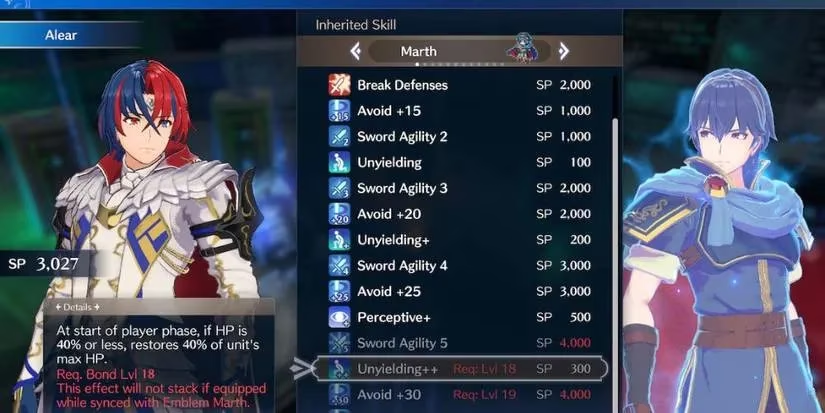
Skills became a language of their own. Momentum added extra punch to her mobility-based playstyle. Build+ from Leif became a treasured inheritance for almost every build, finally letting her carry a full complement of tomes and staves without constant Speed penalties. And Speedtaker from Lyn turned every kill into a snowball of even greater swiftness. In the arena, she practiced endlessly, dodging attacks from Goldmary’s blade and Veyle’s magic, always with that same determined smile.
Looking back from the vantage of 2026, Framme’s story is not one of a hidden powerhouse discovered late, but of a companion whose potential was always there, humming beneath the surface. She is a testament to the idea that a low Build stat is a riddle, not a verdict. Knights and wolf-riders alike still debate the optimal setup—Martial Master for the purists, Griffin Knight for the dreamers, Wolf Knight for the tacticians who believe offense is the best healing. But everyone agrees on one thing: when the dust settles and the final map’s boss theme fades, it’s often Framme’s laughter that rings out first, a staff in one hand and a bloodied dagger in the other, proof that the best healers are those who refuse to stay in the back.