
It has been three years since Fire Emblem Engage swept across the Nintendo Switch, and while the game’s intricate emblem mechanics and tactical depth still draw praise, one thing remains constant: the emotional resonance of its characters. Among a sprawling cast of royals, retainers, and divine dragons, Prince Alcryst of Brodia stands apart—not for godly powers or unshakable valor, but for a painfully authentic struggle with self‑worth. In an era where video game heroes are often larger‑than‑life, Alcryst’s quiet, self‑deprecating journey continues to hit closer to home than any legendary blade ever could.
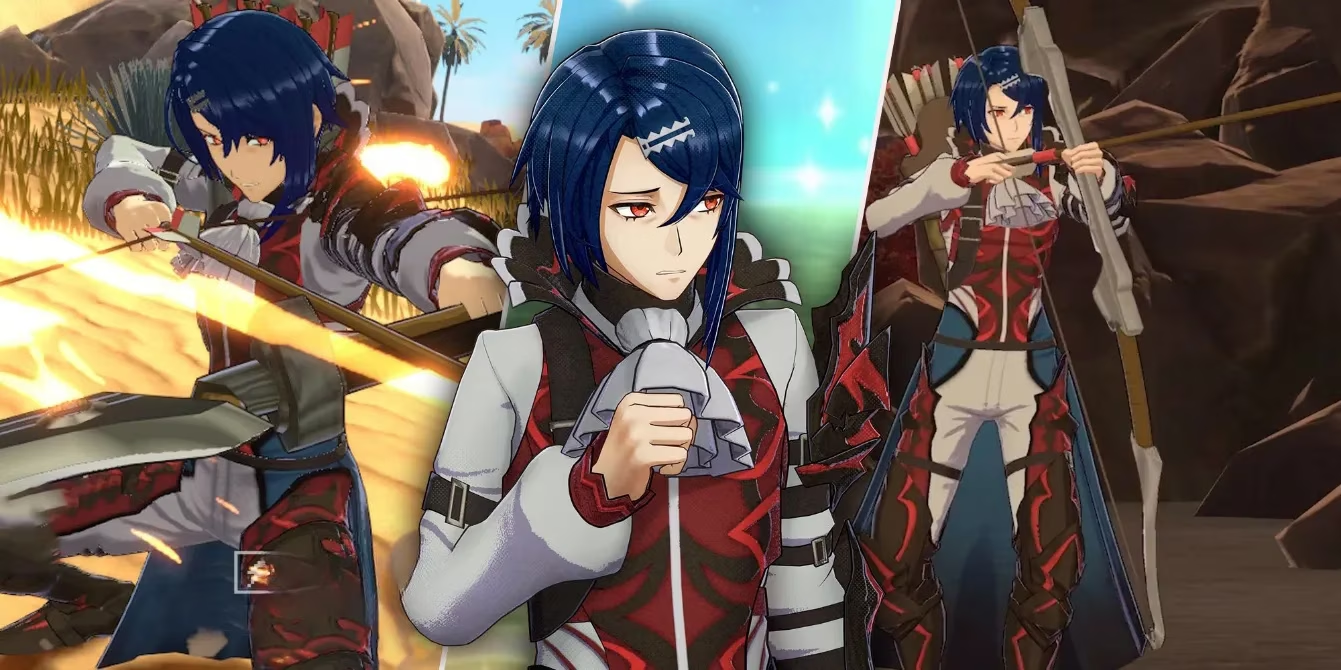
From the moment Alcryst is introduced, the game smashes the traditional prince archetype. Meeting the protagonist Alear for the first time, he mistakes them for an enemy and looses an arrow that barely misses. What follows is not a dignified apology but a full‑body grovel, a scene both comical and shockingly raw. Who among us hasn’t messed up and then over‑corrected with a flood of self‑blame? Alcryst’s immediate reaction—assuming he has ruined everything and judging himself as a burden—sets the stage for one of the most vulnerable character arcs in modern tactical RPGs.
Alcryst is the second son of King Morion of Brodia, forever living in the shadow of his older brother, Crown Prince Diamant. Where Diamant is charismatic, broad‑shouldered, and seemingly flawless, Alcryst sees only his own shortcomings. “I’m sorry for existing” might as well be his catchphrase. Yet this is not mere comic relief; it is a startlingly real depiction of an inferiority complex. How many players saw a reflection of their own sibling dynamics in Alcryst’s constant comparisons? The little voice that says, “She could eat a whole bag of chips and still look good, but I just look at a bag and gain weight,” was transcribed almost verbatim from the hearts of millions who’ve felt overshadowed by a brother or sister.
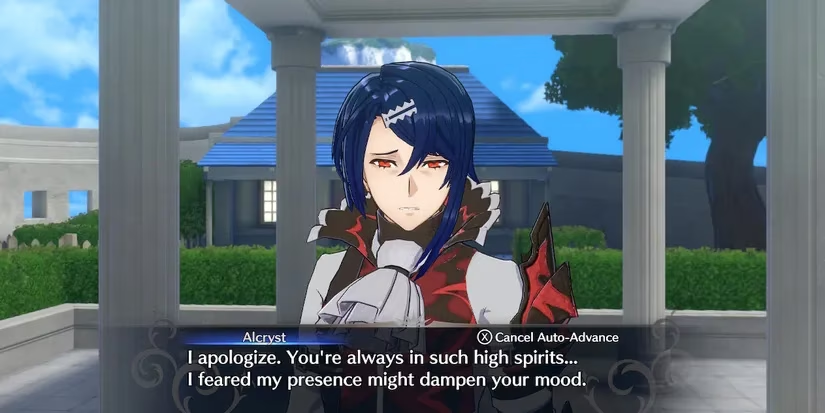
The support conversations between Alcryst and Diamant are the emotional core of this relatability. Across C, B, and A‑rank supports, their interactions evolve from a one‑sided admiration into a genuine, two‑way growth. In their first talk, Alcryst insists he will be a terrible sparring partner because of his “inferior qualities.” Diamant pushes back, encouraging him to see that everyone has strengths. But no matter how hard Diamant tries, Alcryst deflects every compliment with a self‑critique. Eventually, Diamant’s patience frays: he tells Alcryst that such self‑loathing is a weakness that could cost him his life in battle. It’s a tough‑love moment that rings painfully true—how often do we sabotage ourselves by refusing to accept that we might actually be competent?
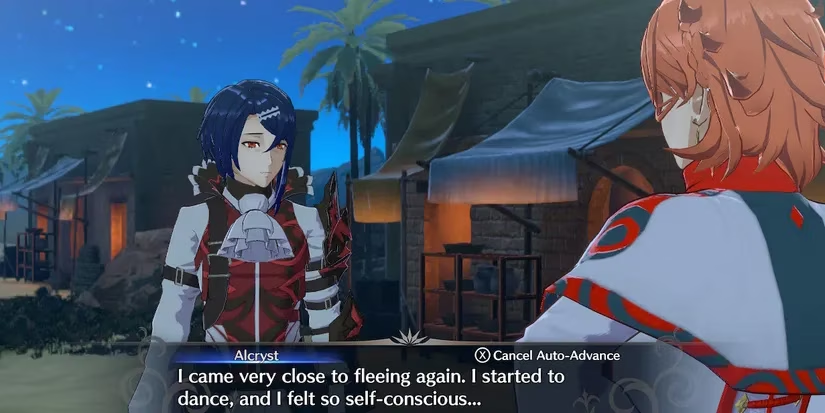
Then the narrative flips the script beautifully. In a later support, Alcryst finds Diamant drenched in sweat, gasping that his own performance wasn’t good enough. The perfect brother, it turns out, has a crippling fear of magic—a childhood trauma he battles daily by training with court mages. Alcryst watches his idol crack, and in doing so, realizes that perfection was always a mirage. This revelation is a masterstroke. It asks the player: if the person you’ve put on a pedestal is just as flawed as you, what’s stopping you from extending yourself the same grace you give them?
Their final support takes place during an archery contest. Alcryst loses, but instead of spiraling into self‑hatred, he frames it as a chance to grow and someday surpass his brother. The shift is subtle but monumental. He has not magically become confident; he has simply learned to see his own potential alongside his perceived flaws. It’s a testament to the writing that Alcryst never loses his anxious core—he learns to coexist with it. In 2026, with mental health awareness at an all‑time high in gaming communities, this portrayal feels more relevant than ever.
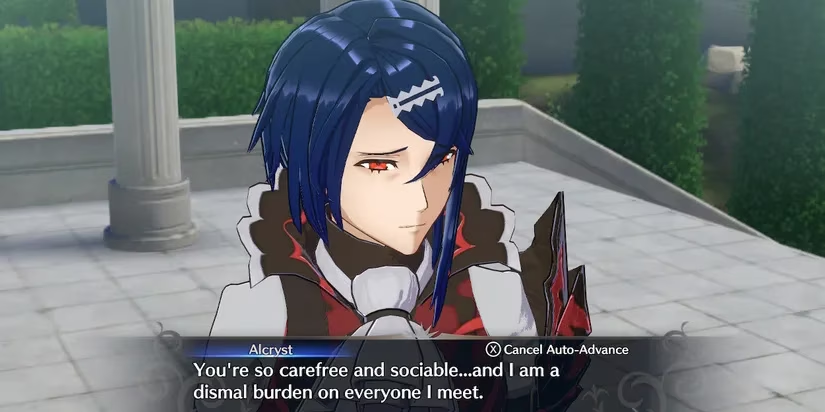
Alcryst’s journey doesn’t end with personal growth. By the game’s epilogue, he is celebrated as a “brilliant yet humble strategist” who restores trust and trade between Brodia and Elusia, and who keeps his brother, the new king, safe. It’s the fulfillment of a promise made to their fallen father. This conclusion proves that his gentleness, so often mistaken for weakness, was actually a quiet strength all along. He never needed to become loud or domineering; he just needed to stop dismissing his own value.
The enduring affection for Alcryst in 2026 speaks to something deeper than plot mechanics. He embodies the internal monologue of the perfectionist, the anxious younger sibling, the person who says “sorry” for taking up space. And yet, he also shows that those traits don’t preclude greatness. In a medium still frequently obsessed with power fantasies, Fire Emblem Engage gifted players a character who battles his own mind more than any foe—and wins. That is why, three years on, Prince Alcryst remains the game’s most relatable figure. Who else could make an arrow shot at the divine dragon feel like a universal apology for being human?